

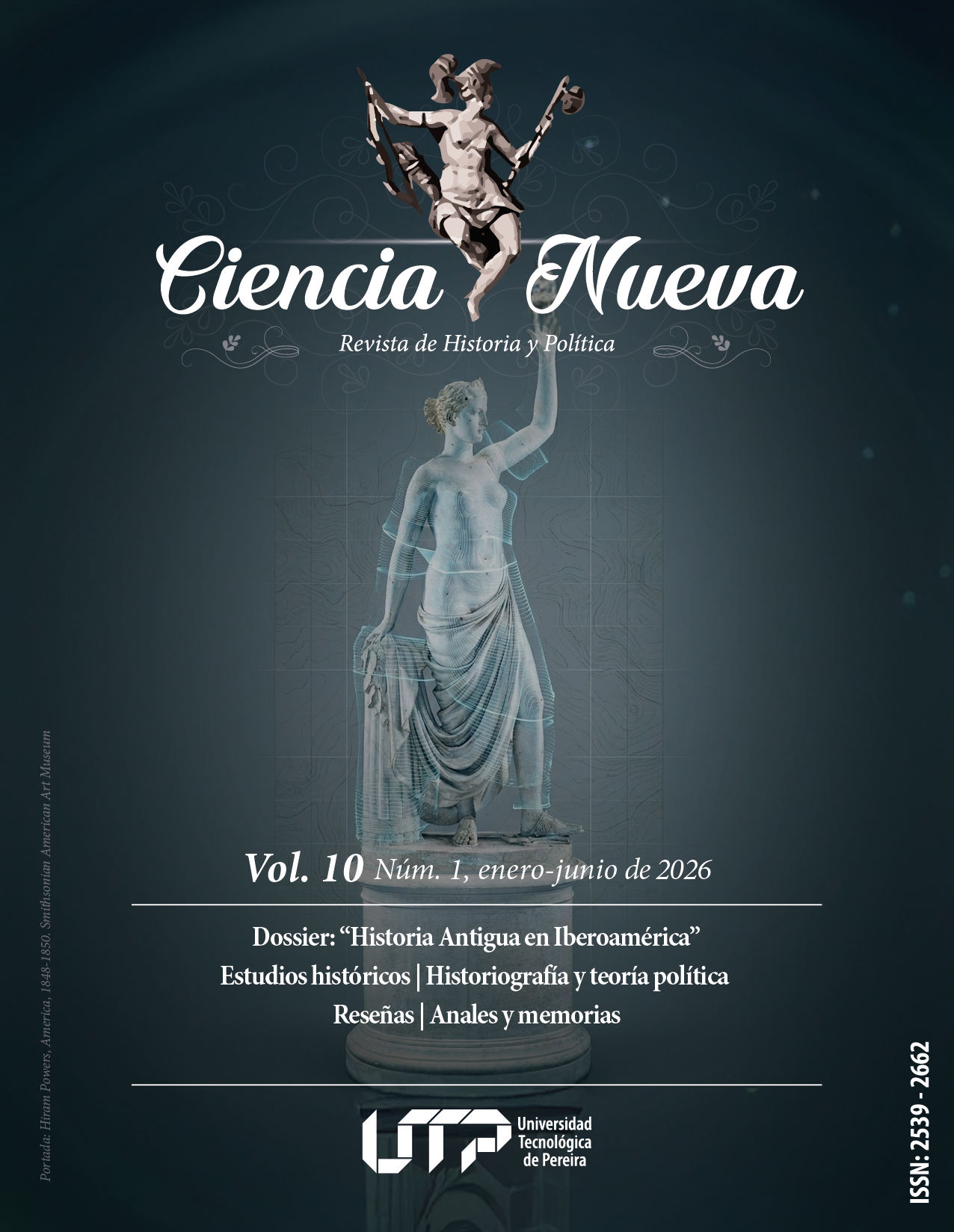
El mito del Minotauro como metáfora para comprender contextos arqueológicos
Avances historiográficos para la conceptualización de naufragios en la arqueología subacuática del siglo XXI
DOI:
https://doi.org/10.22517/25392662.25870Palabras clave:
mito del Minotauro, contextos arqueológicos, naufragios, historiografía, arqueología subacuáticaResumen
La presente investigación buscó comprender cómo Occidente, entendido como una construcción social y cultural fundamentada en distintos legados de la antigüedad y expandido a través de los procesos de la colonización y modernización, ha influido en la producción de conocimiento arqueológico en las últimas décadas. Este sistema cultural ha llegado incluso a plantear formas de conceptualizar la identidad de la cultura material mediante la categoría de lo monstruoso, la cual permite dar cuenta de la complejidad, la hibridez y la heterogeneidad de las evidencias materiales dentro del régimen de historicidad contemporáneo.
Considerando que, en los inicios de la arqueología, las civilizaciones del mar Egeo desempeñaron un papel relevante en la conformación de esta disciplina, así como que algunos elementos de la tradición clásica —en particular el mito del Minotauro— se han utilizado en investigaciones para analizar la cultura material, el presente trabajo empleó dicho mito como marco interpretativo para la construcción de un estado del arte alrededor de la arqueología marítima y subacuática. La finalidad de este trabajo fue identificar las tendencias teórico-metodológicas desde los marcos culturales a partir de los cuales se han interpretado los contextos subacuáticos en la actualidad.
Descargas
Citas
Aldana, Jesús Alberto. «Estado del arte: Reconocimiento de indicadores arqueológicos e históricos para la identificación de navíos». Trabajo académico. Universidad Externado de Colombia, 2025.
Alvik, R. “Wreck of the Dutch Merchant Ship Vrouw Maria: Example of Protection and Management of Underwater Cultural Heritage”. En Competing Values in Archaeological Heritage, vol 7, editado por Geoffrey Scarre y Robin Coningham. Cham: Springer, 2018.
Augé, Marc. Los no lugares: Espacios del anonimato. Una antropología de la sobremodernidad. Traducido por María Teresa Gallego Urrutia. Barcelona: Gedisa, 1993.
Barber, V. C., J. M. Barber, M. Allston y B. Stone. “An Initial Survey of a Wreck, Thought to Be a St Malo Vessel, the Marguerite, Sunk in 1707 at Conche, Newfoundland”. International Journal of Nautical Archaeology 8 (1979): 39–44.
Bauman, Zygmunt. Modernidad líquida. Buenos Aires: Fondo de Cultura Económica, 2003.
Bauman, Zygmunt. Tiempos líquidos. Barcelona: Tusquets, 2007.
Berlin, Isaiah. El sentido de la realidad. Sobre las ideas y su historia. Madrid: Taurus, 1998.
Blue, Lucy y Colin Breen. “Maritime Archaeology and Capacity Development in the Global South”. Journal of Maritime Archaeology 14, n.o 3 (2019): 321–332.
Brennan, Margaret L., Francisca Cantelas, Kimberly Elliott, James P. Delgado, Kathryn L. Bell, Dwight Coleman y Robert D. Ballard. 2018. “Telepresence-Enabled Maritime Archaeological Exploration in the Deep.” Journal of Maritime Archaeology 13, n.o 1 (2018): 97–121. https://doi.org/10.1007/s11457-018-9200-9.
Briggs, L., y P. B. Campbell. “Shipwreck Archaeology in the Past 10 Years”. Archaeological Reports 69 (2023): 131–145.
Campbell, Joseph. El héroe de las mil caras. Traducido por Luis Reyes. Girona: Atalanta, 2008).
Campbell, Peter. B. “Octopodology and Dark Amphorae: Alien Archaeologies, Reflexivity, and the Non-human Afterlives of Objects in the Sea”. En Contemporary Philosophy for Maritime Archaeology. Amsterdam: Amsterdam University Press, 2023.
Delgado, James. P., Ben L. Ford y Molly L. Brennan. 2023. “Nineteenth-Century Shipwrecks and the Maritime Cultural Landscape of the Gulf of Mexico”. Journal of Maritime Archaeology 18, n.o 3 (2023): 371–403.
Diamanti, E., Ø. Ødegård, G. Koutsouflakis y V. Mentogiannis. «Underwater Drones as a Low-Cost, yet Powerful Tool for Underwater Archaeological Mapping: Case Studies from the Mediterranean». Journal of Computer Applications in Archaeology 8, n.o 1 (2025): 10–24. https://doi.org/10.5334/jcaa.184.
Dumas, Frédéric. Arqueología de aguas profundas. Traducido por H. Frost. Londres: Routledge y Kegan Paul, 1962.
Duncan, B., P. Forbes, y G. Jackson. “Wreck Spotting on Planespotting Beach: A Rare Dugout Canoe Washes Ashore”. Signals 148 (2024): 50–52.
Edensor, Tim. “The Ghosts of Industrial Ruins: Ordering and Disordering Memory in Excessive Space”. Environment and Planning D: Society and Space 23, n.o 6 (2005): 829–849.
Fenwick, Valerie y Alison G. Gale. Historic Shipwrecks: Discovered, Protected & Investigated. Stroud: Tempus Publishing, 1998.
Ferentinos, G., E. Fakiris, D. Christodoulou, M. Geraga, X. Dimas, N. Georgiou, ... y M. Sotiropoulos. 2020. “Optimal Sidescan Sonar and Subbottom Profiler Surveying of Ancient Wrecks: The ‘Fiskardo’ Wreck, Kefallinia Island, Ionian Sea”. Journal of Archaeological Science 113 (2020): 105032.
Ferrari, Ben. «Physical, Biological and Cultural Factors Influencing the Formation, Stabilisation and Protection of Archaeological Deposits in U.K. Coastal Waters». Tesis doctoral, University of St Andrews, 1995.
Ford, B. F., J. Halligan, y Alexis. Catsambis. Our Blue Planet: An Introduction to Maritime and Underwater Archaeology. Oxford: Oxford University Press, 2020.
Godin, G. “Monstrous Things: Horror, Othering, and the Anthropocene”. Post-Medieval Archaeology 56, n.o 2 (2022): 116–126. https://doi.org/10.1080/00794236.2022.2120709.
González-Ruibal, Alfredo. An Archaeology of the Contemporary Era. London: Routledge, 2019.
González‑Ruibal, Alfredo y Xurxo Ayán. Arqueología: Una introducción al estudio de la materialidad del pasado. Madrid: Alianza Editorial, 2018.
González-Varas, Ignacio. Las ruinas de la memoria: Ideas y conceptos para una (im)posible teoría del patrimonio cultural. Coyoacán, Ciudad de México: Siglo XXI Editores, 2014.
Grömer, Michael, Erica Nocerino, Alessio Calantropio, Fabio Menna, Ansgar Dreier, Lukas Winiwarter y Gottfried Mandlburger. “High-Detail and Low-Cost Underwater Inspection of Large-Scale Hydropower Dams”. The International Archives of the Photogrammetry, Remote Sensing and Spatial Information Sciences 48 (2024): 115–120, https://doi.org/10.5194/isprs-archives-XLVIII-2-2024-115-2024.
Grøn, O., L. O. Boldreel, M. F. Smith, S. Joy, R. Tayong Boumda, A. Mäder, ... y A. Dell’Anno. “Acoustic Mapping of Submerged Stone Age Sites—A HALD Approach”. Remote Sensing 13, n.o 3 (2021): 445.
Grote, Paul J., Wipanu Rugmai, Sira Ploymukda, Borisut Boriphon y Preeyanuch Jumprom. “Use of In Situ Silica Bodies in Identification of Rope Fibers from the Phanom-Surin Shipwreck, Samut Sakhon, Thailand”. Archaeological and Anthropological Sciences 13 (2021): 1–12.
Hamouda, Amr, Sherif El-Gharabawy, Ahmed Fekry y Mohamed Nassar. “Exploration and Identification of Ancient Roman Shipwreck Located at Quseir, Red Sea”. Egyptian Journal of Aquatic Research 50, n.o 1 (2024): 17-22.
Harman, Graham. “The Shipwreck of Theseus: Philosophy and Maritime Archaeology”. En Contemporary Philosophy for Maritime Archaeology: Flat Ontologies, Oceanic Thought, and the Anthropocene, editado por Sara A. Rich y Peter B. Campbell. Leiden: Sidestone Press, 2023.
Harpster, Michael. “Keith Muckelroy: Methods, Ideas and Maritime Archaeology”. Journal of Maritime Archaeology 4 (2009): 67–82.
Harpster, Matthew. “Shipwreck Identity, Methodology, and Nautical Archaeology.” Journal of Archaeological Method and Theory 20 (2013); 588–622.
Hartog, François. Regímenes de historicidad: Presentismo y experiencias del tiempo. Traducido por Jorge León Casero. México: Universidad Iberoamericana/Bonilla Artigas Editores, 2012.
Hofmeyr, Isabel y Charne Lavery. “Oceanic Humanities for Blue Heritage”. En The Palgrave Handbook of Blue Heritage, 31–40. Cham: Springer International Publishing, 2022.
Johnston, P. F., J. O. Sands, y J. R. Steffy. “The Cornwallis Cave Shipwreck, Yorktown, Virginia. Preliminary Report”. International Journal of Nautical Archaeology 7 (1978): 205–226.
Jowitt, Claire, Craig Lambert y Steve Mentz, eds. The Routledge Companion to Marine and Maritime Worlds, 1400–1800. New York: Routledge, 2020.
Karauwan, Muhammad y Yustina Gumolili. “Identification of the Condition of the Shipwreck as a Diving Tourism Object in the Waters of 'Tawara' Bunaken National Park, North Sulawesi Province”. Jurnal Ilmiah PLATAX 11, n.o 2 (2023): 702–709.
Koutsouflakis, Georgios y Peter B. Campbell. “Roman and Late Roman Pontic Cargoes in the Aegean: The Evidence from Shipwrecks”. En The Greeks and Romans in the Black Sea and the Importance of the Pontic Region for the Graeco-Roman World (7th Century BC–5th Century AD): 20 Years On (1997–2017), editado por Gocha R. Tsetskhladze et al., 267-284. Oxford: Archaeopress, 2021.
Lowenthal, David. El pasado es un país extraño. Traducido por José Luis Gil Aristu. Madrid: Cambridge University Press-Ediciones Akal, 2015.
Mayhew, D. R. “The Defense. Search and Recovery, 1972–73”. International Journal of Nautical Archaeology 3 (1974): 312–313.
McAllister, M. y W. van Duivenvoorde. “Environmental Scanning Electron Microscopy of Copper Alloy Artefacts from Unidentified Shipwreck Sites: Clues to the Identity of Shipwrecks on Kenn Reef, Coral Sea”. Journal of Archaeological Science: Reports 57 (2024): 104622.
McCarthy, M. “The Excavation and Identification of the Ex-American Whaler Day Dawn”. International Journal of Nautical Archaeology 8 (1979): 143–154.
McConnell. A. “O salvamento da HMS Thetis em 1830”. Revista Marítima Brasileira (1986).
Mentz, Steve. An Introduction to the Blue Humanities. London: Routledge, 2023.
Ministerio de las Culturas, las Artes y los Saberes. Proyecto de investigación científica: «Hacia el corazón del Galeón San José»: Perspectiva interdisciplinar para la investigación sobre factores de incidencia en el proceso de formación de sitio y los modelos de degradación de los materiales pertenecientes al contexto arqueológico del naufragio del Galeón San José. Informe final 2024. Cartagena de Indias: Ministerio de las Culturas, las Artes y los Saberes, 2024.
Missiaen, Tine, Dimitris Sakellariou y Nicholas C. Flemming. “Survey Strategies and Techniques in Underwater Geoarchaeological Research: An Overview with Emphasis on Prehistoric Sites”. En Under the Sea: Archaeology and Palaeolandscapes of the Continental Shelf, editado por Geoffrey N. Bailey, N. C. Flemming y otros, 21-37. Cham: Springer, 2017. https://doi.org/10.1007/978-3-319-53160-1_2 .
Morton, Timothy. Hiperobjetos: Filosofía y ecología después del fin del mundo. Madrid: La Caja Books, 2013.
Morton, Timothy. Hyperobjects: Philosophy and Ecology After the End of the World. Minneapolis: University of Minnesota Press, 2013.
Mugnai, Francesco, Andrea Ridolfi, Marco Bianchi, Marco Franchi y Grazia Tucci. “Developing Affordable Bathymetric Analysis Techniques Using Non-Conventional Payload for Cultural Heritage Inspections”. The International Archives of the Photogrammetry, Remote Sensing and Spatial Information Sciences 42 (2019): 807–811, https://doi.org/10.5194/isprs-archives-XLII-2-W15-807-2019.
Nikolaus, J., K. Westley, y C. Breen. “Endangered Maritime Archaeology in North Africa–The MarEA Project”. Libyan Studies 54 (2023): 135–150.
Ødegård, Ø., A. J. Sørensen, R. E. Hansen, y M. Ludvigsen. “A New Method for Underwater Archaeological Surveying Using Sensors and Unmanned Platforms” IFAC-PapersOnLine 49, n.o 23 (2016): 486–493.
Olsen, Bjørnar y Þóra Pétursdóttir, eds. Ruin Memories: Materialities, Aesthetics and the Archaeology of the Recent Past. Londres: Routledge, 2014.
Özdaş, Harun, y Nergis Kızıldağ. “Archaeological and Geophysical Investigation of Submerged Coastal Structures in Kekova, Southern Coast of Turkey.” Geoarchaeology 28, n.o 5 (2013): 504–516.
Paxton, Avery B., Christopher McGonigle, Melanie Damour, Georgia Holly, Alicia Caporaso, Peter B. Campbell, Kirstin S. Meyer-Kaiser, Leila J. Hamdan, Calvin H. Mires y J. Christopher Taylor. “Shipwreck Ecology: Understanding the Function and Processes from Microbes to Megafauna”. BioScience 74, n.o 1 (2024): 12–24. https://doi.org/10.1093/biosci/biad084.
R. Plets, J. Dix, y R. Bates. Marine Geophysics Data Acquisition, Processing and Interpretation. York: University of York, 2013.
Recinos, Kimberly y Lucy Blue. “Improving Capacity Development for Threatened Maritime and Marine Cultural Heritage Through the Evaluation of a Parameter Framework”. Journal of Maritime Archaeology 14 (2019): 409–427.
Rich, Sara. "Shipwreck Hauntography: Underwater Ruins and the Uncanny". En Hauntology and Interdisciplinary Research, ed. Katy Soar and Emma Bridges, 25. Amsterdam: Amsterdam University Press, 2021. https://doi.org/10.5117/9789463727709.
Rich Sara A. y Peter B. Campbell, eds. Contemporary Philosophy for Maritime Archaeology: Flat Ontologies, Oceanic Thought, and the Anthropocene. Leiden: Sidestone Press, 2023.
Rost, H. «Dos Naufragios Carios». Antiquity 34, n.o 135 (1960): 216–218. https://doi.org/10.1017/S0003598X00119131.
Scarre Chris y Brian M. Fagan. Ancient Civilizations, 3rd ed. New Jersey: Pearson Education, 2008.
Schiffer, Michael. «Los procesos de formación del registro arqueológico». Boletín de Antropología Americana, n.o 23 (1991): 39-52.
Semaan, Lucy. “Maritime Archaeology in Post-War Lebanon: The Trade, Challenges, and Future Prospects”. En IKUWA6. Shared Heritage: Proceedings of the Sixth International Congress for Underwater Archaeology, 28 November–2 December 2016, Western Australian Maritime Museum, Fremantle, Western Australia, editado por J. Rodrigues y A. Traviglia, 172–185. Oxford: Archaeopress Publishing Ltd, 2020.
Throckmorton, Peter. Shipwrecks and Archaeology: The Unharvested Sea. Boston/Toronto: Little, Brown and Company, 1970.
Tuddenham, D. B. “Maritime Cultural Landscapes, Maritimity and Quasi Objects”. Journal of Maritime Archaeology 5 (2010): 5–16.
UNESCO. Convention on the Protection of the Underwater Cultural Heritage. Paris: UNESCO, 2001.
UNESCO. Manual for Activities Directed at Underwater Cultural Heritage. Paris: UNESCO, 2013.
UNESCO. «Meeting of States Parties to the 2001 Convention on the Protection of the Underwater Cultural Heritage, Ninth Session». París, 13–14 de junio de 2023.
Ward, I., P. Larcombe, y P. Veth. “Towards New Process-Orientated Models for Describing Wreck Disintegration”. Bulletin of the Australian Institute of Maritime Archaeology 22 (1998): 109–111.
Wiseman, C., Myra O’Leary, James Hacker, Fred Stankiewicz, Jonathan McCarthy, Edward Beckett et al. “A Multi-Scalar Approach to Marine Survey and Underwater Archaeological Site Prospection in Murujuga, Western Australia”. Quaternary International 584 (2021): 152–170.
Vernant, Jean-Pierre. Mito y sociedad en la Grecia antigua. Prólogo de Carlos García. Madrid: Ediciones Akal, 1996.
Descargas
-
Vistas(Views): 430
- PDF Descargas(Downloads): 180
Publicado
Cómo citar
Número
Sección
Licencia
Derechos de autor 2026 Gabriela Caro Leon, Carlos Del Cairo Hurtado, Jesus Alberto Aldana Mendoza, Carla Riera Andreu

Esta obra está bajo una licencia internacional Creative Commons Atribución-NoComercial-SinDerivadas 4.0.
Para todos los artículos publicados en Ciencia Nueva, revista de Historia y Política, la titularidad de los derechos de explotación de los contenidos de la revista pertenece al autor o los autores.
Las obras de esta revista están bajo la licencia Creative Commons Reconocimiento-NoComercial-SinObraDerivada:
