


Implementation of a neural network and a forrester model for the prediction between demographic factors and pollutants
DOI:
https://doi.org/10.22517/23447214.25177Keywords:
Mathematical model, neural network, Forrester diagram, demographic behavior, environmental pollution, CO2, pm2.5Abstract
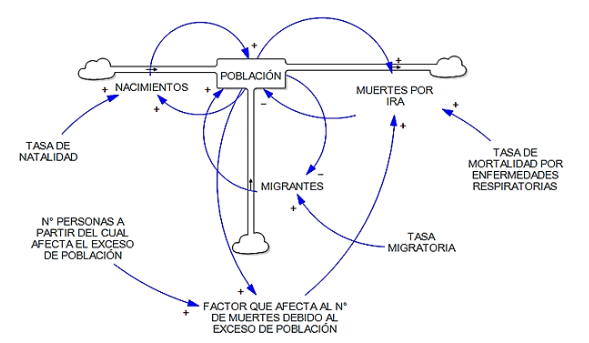
The greatest problems that has been presented in the world, especially in Colombia, is due to an accelerated population growth generated by the overwhelming increase in migrant circulation or mobility of people due to other causes or eventual situations of nature. These social situations have been significantly affecting the urban order of cities, particularly due to the confinement of the population and the increase in environmental pollution that this increase brings, in addition to unhealthiness, poverty, among other factors. To study population growth based on demographic variables and environmental factors, an Artificial Neural Network was built to carry out a data analysis that incorporated related variables such as CO2 and other pollutants. The purpose was to identify the influence of these toxic agents with the growth of a population. Once the dynamic prediction was verified through the neural network, a mathematical model was built to study a specific case of demographic behavior for a certain Colombian region by means of a Forrester Diagram, where the migratory conditions, birth rate, morbidity, mortality, migratory flow (or mobility of people due to other natural events) and pollutants that affect human health mainly in respiratory diseases. The results delivered predictions and the Forrester Diagram confirming the relationship between toxic agents and demographic aspects.
Downloads
References
K. Tovar, Z. Gómez, and A. Zamorategui, “Monitoreo de contaminantes atmosféricos (PM2.5 , PM10 y CO2 ) y variables meteorológicas (temperatura, humedad relativa, velocidad y dirección del viento) en la ciudad de Guanajuato,” Jóvenes en la Cienc. Rev. Divulg. Científica, vol. 5, no. 1, pp. 347–352, 2017, [Online]. Available: https://bit.ly/3PqjsE1
Instituto para la salud geoambiental, “Medición Gas Radón,” 2022. https://www.saludgeoambiental.org/dioxido-carbono-co2/
J. Gao, Z. Qiu, W. Cheng, and H. O. Gao, “Children’s exposure to BC and PM pollution, and respiratory tract deposits during commuting trips to school,” Ecotoxicol. Environ. Saf., vol. 232, p. 11, 2022, DOI: 10.1016/j.ecoenv.2022.113253.
Y. H. Cheng, Z. S. Liu, and J. W. Yan, “Comparisons of PM10, PM2.5, particle number, and CO2 levels inside metro trains traveling in underground tunnels and on elevated tracks,” Aerosol Air Qual. Res., vol. 12, no. 5, pp. 879–891, 2012, DOI: 10.4209/aaqr.2012.05.0127.
M. E. Blanco Chávez, I. Gómez Carvajal, and S. Mena Bonilla, “CO2 y PM2 . 5 en la oficina de docentes del Departamento de Operaciones Unitarias,” Arquit. +, vol. 7, pp. 27–35, 2022, DOI: 10.5377/arquitectura.v7i13.14438.
C. Zhang, C. Miao, W. Zhang, and X. Chen, “Spatiotemporal patterns of urban sprawl and its relationship with economic development in China during 1990 – 2010,” Habitat Int., vol. 79, no. July, pp. 51–60, 2018, DOI: 10.1016/j.habitatint.2018.07.003.
B. A. Garro, K. Rodríguez, and R. A. Vázquez, “Classification of DNA microarrays using artificial neural networks and ABC algorithm,” Appl. Soft Comput., vol. 38, pp. 548–560, 2015, DOI: 10.1016/j.asoc.2015.10.002.
F. E. Ahmed, “Artificial neural networks for diagnosis and survival prediction in colon cancer,” Mol. Cancer, vol. 4, pp. 1–12, 2005, DOI: 10.1186/1476-4598-4-29.
Departamento Administrativo Nacional de Estadística DANE, “Dane. Estimaciones del cambio demográfico.” https://www.dane.gov.co/index.php/estadisticas-por-%0Atema/demografia-y-poblacion/estimaciones-del-cambio-demografico
“Banco de datos. Indicadores del desarrollo mundial,” 2021. https://databank.bancomundial.org/reports.aspx?%0Asource=2&country=COL
G. Suárez Guerrero, E. E. Clavijo Gañan, and Universidad Pontificia Bolivariana, “Una propuesta metodológica para una mayor comprensión e interpretación del comportamiento de los fenómenos naturales : A partir de la observación hasta obtener las respuestas del comportamiento del fenómeno . Una propuesta metodológica para una mayor comp,” Mendomatemática, vol. 20, pp. 1–9, 2009.
J. Aracil, Publicaciones de Ingeniería de Sistemas: Dinámica de sistemas. 1995. [Online]. Available: http://s3.amazonaws.com/academia.edu.documents/30937935/Aracil_Gordillo_DS.pdf?AWSAccessKeyId=AKIAJ56TQJRTWSMTNPEA&Expires=1459994585&Signature=RWjAdKFm/D+Aeud+2RUzsgqpCmw=&response-content-disposition=inline; filename=Dinamica_de_sistemas.pdf
Ministerio De Relaciones Exteriores, “Política Integral Migratoria,” 2022. https://www.cancilleria.gov.co/colombia/migracion/politica
N. OspinaCifuentes and M. C. García Álvarez, “Organizational evaluation using a computational tool for the analysis of critical factors,” LACCEI Int. Multi-Conference Eng. Educ. Technol., no. July, pp. 19–21, 2018, DOI: http://dx.doi.org/10.18687/LACCEI2018.1.1.472.
Departamento Administrativo Nacional de Estadística DANE, “Comunicado Oficial,” Comité Nacional para la Vigilancia Epidemiológica (CONAVE), 2020. https://www.gob.mx/cms/uploads/attachment/file/573732/Comunicado_Oficial_DOC_sospechoso_ERV_240820.pdf
A. Beltrán and A. R. Grippa, “Políticas efectivas para reducir la mortalidad infantil en el Perú: ¿Cómo reducir la mortalidad infantilen las zonas más pobres del país?,” Cent. Investig. la Univ. del Pacífico, pp. 1–45, 2004.
F. Díez Ballester, J. M. Tenías, and S. Pérez Hoyos, “Efectos de la contaminación atmosférica sobre la salud: Una introducción,” Esp Salud Pública, vol. 73, pp. 109–121, 1999. DOI: 10.1590/S1135-57271999000200002
L. Liu, J. Fang, M. Li, M. A. Hossin, and Y. Shao, “The effect of air pollution on consumer decision making: A review,” Clean. Eng. Technol., vol. 9, no. December 2020,p.100514, 2022, DOI: 10.1016/j.clet.2022.100514.
G. He and T. Lin, “Does air pollution impair investment efficiency?,” Econ. Lett., vol. 215, p. 110490, 2022, DOI: 10.1016/j.econlet.2022.110490.
M. Timothy, “Demographic models for projections of social sector demand,” CEPAL-población y Desarrollo., vol. 66, no. June, pp. 1–63, 2006.
M. Parves and I. N. Ilina, “Climate change and migration impacts on cities : Lessons from Bangladesh,” Environ. Challenges, vol. 5, no. May, p. 100242, 2021, DOI: 10.1016/j.envc.2021.100242.
S. Ayoub, A. Adnan, A. Abdullah, O. Mohammed, W. Sami, and D.C. Klonoff, “Effect of environmental pollutants PM-2.5, carbon monoxide, and ozone on the incidence and mortality of SARS-COV-2 infection in ten wild fi re affected counties in California,” Sci. Total Environ., vol.757, p.143948, 2021, DOI: 10.1016/j.scitotenv.2020.143948.
S. Dong, C. Wang, Z. Han, and Q. Wang, “Projecting impacts of temperature and population changes on respiratory disease mortality in Yancheng,” Phys. Chem. Earth, vol. 117, p. 102867, 2020, DOI: 10.1016/j.pce.2020.102867.
H. Yin et al., “Population ageing and deaths attributable to ambient PM 2.5 pollution: a global analysis of economic cost,” Lancet Planet. Heal., vol. 5, no. 6, pp. e356–e367, 2021, DOI: 10.1016/S2542-5196(21)00131-5.
J. M. Rodríguez Navarrete, “Los factores ambientales como determinantes del estado de salud de la población en el municipio de Soacha 2006-2016,” Pontificia Universidad Javeriana, 2018. [Online]. Available: https://repository.javeriana.edu.co/handle/10554/46829?show=full
J. A. Ezquerro Fernández, Iniciación a los métodos numéricos, Universida. 2012.
Cámara de Comercio de Bogotá, Plan económico para la competitividad del municipio de Soacha. 2009.
N. OspinaCifuentes and M. C. García Álvarez, “Organizational evaluation using a computational tool for the analysis of critical factors,” LACCEI Int. Multi-Conference Eng. Educ. Technol., no. July, pp. 19–21, 2018, DOI: 10.18687/LACCEI2018.1.1.472.
G. Valerio et al." Use of official municipal demographics for the estimation of mortality in cities suffering from heavy environmental pollution: Results of the first study on all the neighborhoods of Taranto from 2011 to 2020". Environmental Research, Volume 204, Part B, March 2022, 112007. DOI: 10.1016/j.envres.2021.112007.
Downloads
-
Vistas(Views): 661
- PDF (Español (España)) Descargas(Downloads): 403
- HTML (Español (España)) Descargas(Downloads): 30
Published
How to Cite
Issue
Section
License
Copyright (c) 2023 Scientia et Technica

This work is licensed under a Creative Commons Attribution-NonCommercial-ShareAlike 4.0 International License.
The undersigned authors declare that the article submitted to the journal Scientia et Technica is an original work and that all its content is free of third-party copyright restrictions or has the corresponding authorizations. Consequently, the authors assume responsibility for any litigation or claim related to intellectual property rights, releasing the Technological University of Pereira and the journal Scientia et Technica from any liability.
If the submitted work is accepted for publication, the authors retain copyright to the article and grant the journal Scientia et Technica the right of first publication, as well as a non-exclusive, perpetual license to reproduce, edit, distribute, display, and publicly communicate the article in any medium or format, including print, electronic, databases, repositories, the Internet, or other scientific dissemination systems. The authors agree that the article will be published in open access and distributed under the Creative Commons Attribution-NonCommercial-ShareAlike 4.0 International License (CC BY-NC-SA 4.0).
The journal Scientia will respect in all cases the moral rights of the authors, in accordance with the provisions of article 30 of Law 23 of 1982 of the Republic of Colombia, recognizing the authorship of the work, the right to integrity and the right of disclosure, which are inalienable and non-waivable.